White paper, Natalia Analytics
Managing phone reception quality when the phone is the business
Field feedback from a distribution network for medical devices sold through pharmacies, gathered from its director after several weeks of using Natalia Analytics.
Why this testimonial is anonymous
The customer asked to remain unnamed. The subject is strategic for them, and they would rather not tell competitors where they invest. The quotes below are their own words, anonymization aside.
A sector where the phone is still the first point of contact
In the distribution of medical devices through pharmacies, the relationship does not start on a website. It starts with a call: a pharmacist checking availability, a family worried about a delivery, a healthcare professional who needs an answer right now.
The phone is the entry point, and it is the heart of our business. That is where we are good, or where we are bad.
A multi-branch network adds a further difficulty. Each site has its own team, its own habits, its own workload. The quality a customer perceives depends on which branch picks up, and head office has no direct visibility on what is said there.
The blind spot: nobody knows what really happens on the phone
Most organizations measure the phone through whatever the PBX can produce: call volume, answer rate, average duration, missed calls. Those indicators say how many calls came in. They say nothing about what happened during the call.
What is missing is the content: the reason, the complaint, the answer given, the tone used. That material exists, but it stays locked in recordings nobody has time to listen to, or copied by hand into notebooks and spreadsheets.
We had nothing to analyze it with.
The cost of that blind spot runs two ways. On quality, a recurring problem can last months before anyone hears about it. On skills, a manager preparing a one-to-one review has no factual material: they work on impressions, or they spend evenings listening to calls.
Reading calls by hand is possible, but it does not scale. The director we interviewed spent a large part of a day going through the conversations of a single site.
It is extremely time-consuming. If you really want to get to the bottom of it, it takes an enormous amount of time.
That reading also happens after the fact. Without continuous analysis, a company learns a problem exists at the moment the customer tells them, which is usually too late.
What Natalia Analytics does
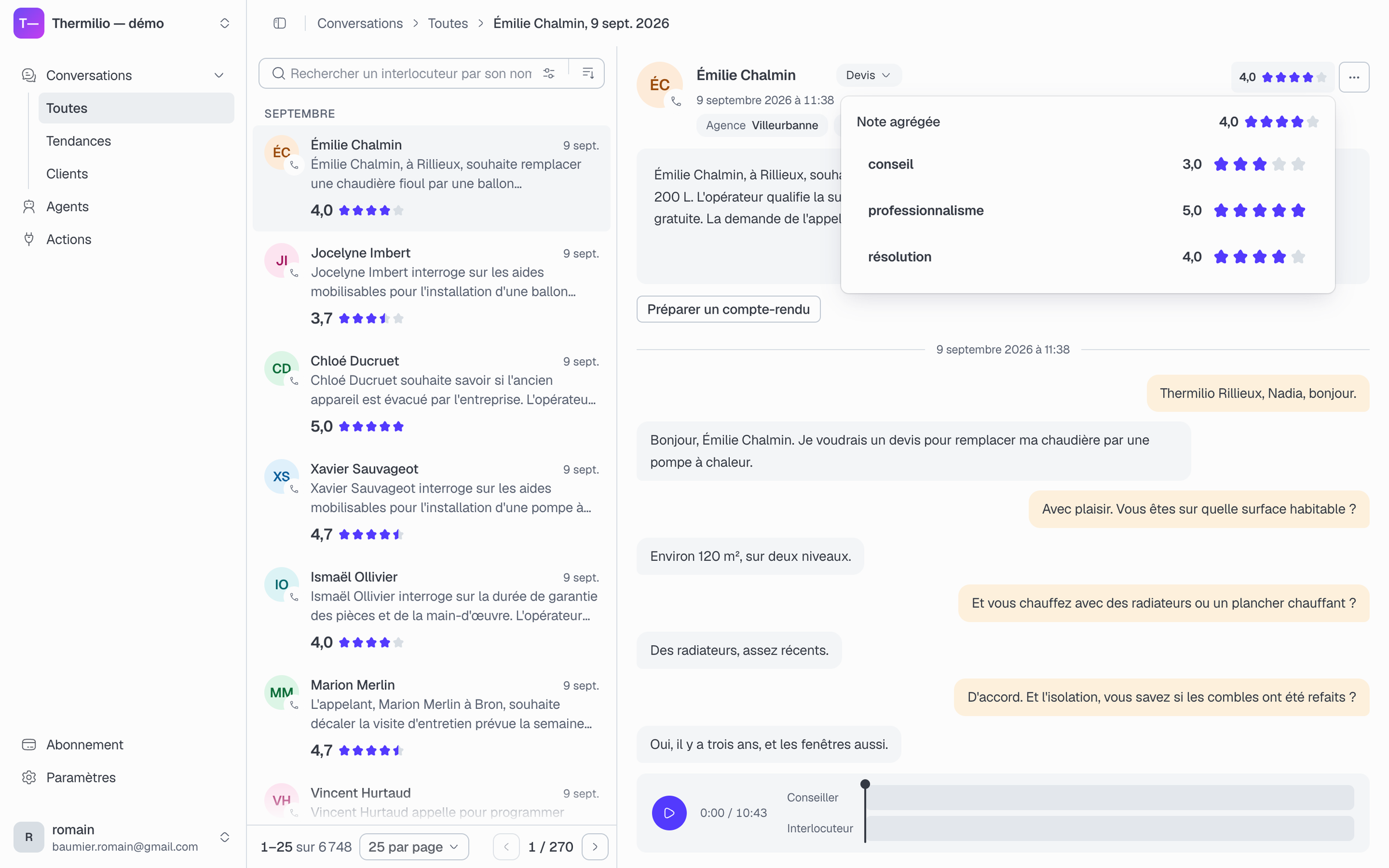
Natalia Analytics plugs into the existing telephony and processes every inbound conversation.
Transcription
Every call becomes readable, searchable text. The audio stays available: reading is fast, listening brings back the tone.
Categorization
Each conversation is filed by reason. A user's correction becomes an instruction for the analyses that follow.
Quality scoring
Each exchange gets a score, revisable only by the person authorized in the settings.
Summaries
An aggregate view of what came up over a period: recurring themes, complaints, requests.
Reporting
Indicators break down by branch and by person, with a read on how they move over time.
Targeted listening
The analysis ranks, the ear decides. A manager listens back to the calls the tool pushed up.
What a multi-branch network does with it, day to day
The feedback covers 8 concrete uses.
Manage quality, site by site
Management gets a consistent read on what happens at every branch, without depending on what each one chooses to report.
Take a branch's temperature without waiting
An immediate read on a site and its customer base, instead of learning a problem exists once the customer finally says so.
Check that operations downstream hold up
On the phone, customers also comment on lead times, deliveries and products. That stream of feedback becomes a sensor on the whole chain, not just on reception.
Measure what each call reason really weighs
Categorization exposes the share each type of request represents. Seeing that a single reason takes up a large slice of calls makes the decision obvious.
Grow the team's skills
Transcripts and scores give one-to-one reviews something factual to work from. The conversation covers real calls, not impressions.
Surface what management needs to know
Summaries expose recurring complaints and requests. Friction over a price, a product or a lead time becomes visible within days.
Get a weekly recap
A summary email to branch managers removes the need to log into a dashboard on your own initiative: call volume, score, complaints.
Staff against the call peaks
Knowing how calls spread across the day makes staffing adjustable: reinforce the busy slots, lighten the quiet ones.
What the director takes away
This tool is brilliant. It lets me manage quality and manage skills.
It is a remarkable quality control tool, one that lets you correct and help your teams improve.
The summary tool saves time. It will spare us hours of spreadsheets.
It lets you take the temperature of a branch and of its customer base, instead of waiting for customers to speak up.
It also lets me see whether my logistics are holding up.
The scoring is really good.
It is a real tool for follow-up and skills development, useful for one-to-one reviews.
It can serve as a motivation and goal-setting tool, for a team as much as for an individual.
The weekly analysis takes two hours, action plan included.
The clearest signal did not come from head office
A branch manager, in the middle of turning around a struggling site, saw the tool demonstrated and asked for it himself.
I walked him through the tool and showed him everything. He told me: I want this.
A management tool the field asks for does not face the same adoption problem as one imposed from above.
AI serving people
Analyzing work conversations touches directly on the people having them. That is a serious subject, and the director raised it himself.
This is exactly how I picture AI: serving people and decision-making, while keeping human judgement in the loop.
He adds that he still listens to certain calls after reading the transcript, because the tone sometimes changes his mind. That is the right use: the tool sorts and ranks, the decision stays human.
The evaluation covers the conversation
The score qualifies an exchange and how it was resolved. It does not produce an automated judgement on an employee.
Human correction takes precedence
The designated manager revises a score or a category, and that correction overrides the machine's proposal.
Corrections are recorded
When an evaluation is changed, the reason is stored. That documents the human decision and sharpens later analyses.
No inference of emotional state
The analysis covers the content and resolution of the exchange. It infers neither the emotion nor the affective state of individuals, a practice the European regulation prohibits in the workplace.
The European AI Act specifically frames systems used in worker management. These principles are not a formality: they condition how the tool can be deployed inside a company.
What deployment requires on your side
Analyzing calls handled by employees is a regulated matter. Three obligations fall on the company deploying the tool, and we would rather state them up front than let you discover them later.
- Inform your employees. No monitoring system may collect information about an employee without having been brought to their attention beforehand.
- Consult your works council. In France, introducing a system that monitors activity requires consulting the CSE before it goes live.
- Run a data protection impact assessment. A DPIA is expected for this type of processing. We provide a template and the technical details it requires.
Where to start
The rollout described here followed a simple path: one pilot site, one manager who actually uses the tool for a month, a first review, then extension to the other branches.
That sequence has one merit: it verifies on a small scope that the tool delivers before committing a whole network, and it calibrates the categories and the scoring grid with the people who actually answer the phone.
See what your own calls say
If phone reception is a critical entry point for you and you have no visibility on its content today, we can show you what Natalia Analytics produces on your own calls.