Natalia On-Premise Security
Architecture designed to pass a fast CISO audit in Strict mode. NIST SP 800-53 / ISO 27001 / ANSSI referenced.
3 contractual modes — summary
Security guarantees depend on the contractual mode selected at installation. Full reference: contractual modes matrix.
Disconnected architecture (Strict mode)
- → No outbound connectivity required for nominal operation.
- → Data processed and stored exclusively on your infrastructure.
- → Local logs only.
- → No Natalia sub-processor.
- → No GDPR art.28 DPA to sign.
Encryption
At-rest
Industry-standard encryption (NIST SP 800-175B algorithms) applied to configuration and datastore on the appliance.
In-transit
TLS 1.2+, customer-provided or self-signed certificates for the local web UI.
PII encryption
Column-level encryption (ChaCha20-Poly1305, per-tenant key) for phone numbers. Decryption is restricted to the Admin role and individually audited; the Viewer role only ever sees a masked number. Search is performed on a non-reversible fingerprint, never on the plaintext number.
RBAC — 4 roles
Viewer
Read-only analytics dashboard.
Admin
Configuration, export, and audited "phone reveal" procedure.
Auditor
Read-only access to audit log + reveal log.
Integrator
License management. No CDR access.
Authentication & failed-login handling
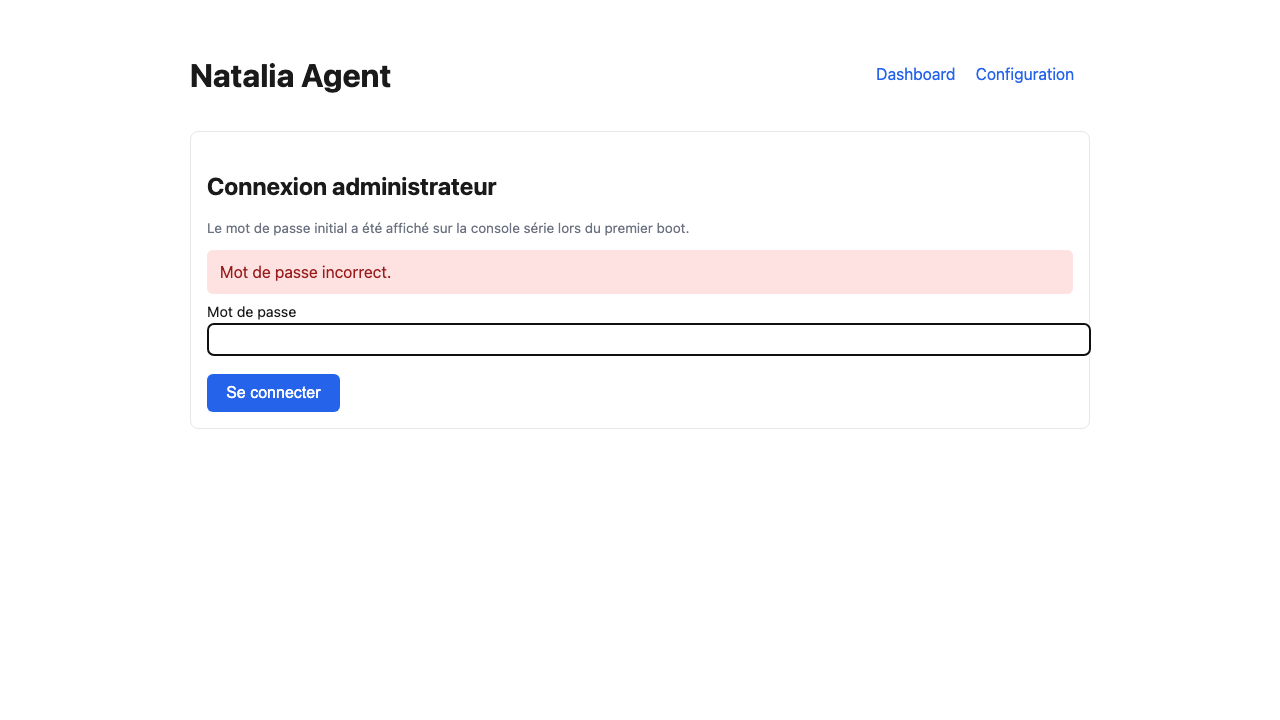
Authentication is local. Failed logins are surfaced explicitly to the operator, throttled at the source, and recorded as a discrete event in the audit log so an Auditor can review them later.
- → Strong password hashing (Argon2id, OWASP 2025 parameters).
- → Rate-limited login attempts with exponential backoff.
- → No silent failure: each error is visible to the operator and audited.
Immutable audit log
- → Every sensitive action is logged with a signed timestamp.
- → Cryptographic integrity verification via hash chain.
- → CSV export to your SIEM (Splunk, ELK, Graylog).
- → Configurable retention (default: 13 months).
License & integrity verification
- → Local cryptographic license verification (Ed25519, NIST FIPS 186-5).
- → No network communication required for validation.
- → Post-expiry grace period (preventive alert before lockout).
- → Clock-tampering / rollback detection.
VM hardening
- → Minimalist hardened VM image (CIS Benchmark Level 1).
- → Process confinement (NoNewPrivileges, ProtectSystem=strict, RestrictSUIDSGID).
- → No user shell, administration via serial console + web UI.
Reversibility / portability
- → Standard CDR export (CSV, JSON).
- → Standard SQL dump.
- → Portable OVA across hypervisors.
GDPR art.17 — right to erasure
- → Selective erasure procedure by extension (cascading on all associated CDRs).
- → Erasure certificate issued.
RFP appendix
- → Pre-filled CISO questionnaire (on request under NDA, CAIQ-Lite / SIG-Lite format).
- → Editor letter (CVE disclosure commitment, security support, CycloneDX SBOM on request).
- → Frameworks: NIST SP 800-53 Rev.5 (AC/AU/SC/IR), ISO 27001:2022 Annex A, ANSSI hygiene guide.